
Search Asheville Voter Registration
Start with the official NCSBE Voter Search. It is free, needs no account, and requires JavaScript. Enter the first and last names as they appear on the registration. For a common name, add the birth year and choose Buncombe County. At least one status box must be selected. “Registered” checks current voter rolls, while “Removed or Denied” can surface a record that is no longer active.
The search form uses these exact controls. The birth field asks only for a year because a full date of birth is not part of the public display.
| Search field | Control | Required | How to use it |
|---|---|---|---|
| First Name | Text | Yes | Use the registration first name. |
| Middle Initial | Text | No | Enter one initial to narrow a match. |
| Last Name | Text | Yes | Use the registration surname. |
| Year of Birth | Dropdown | No | Select a year, not a full birth date. |
| County | Dropdown | No | Choose Buncombe from all 100 counties. |
| Voter Status | Checkboxes | Yes | Select Registered, Removed or Denied, or both. |
| Search / Reset | Buttons | Not applicable | Run the query or clear all fields. |
Search results should be treated as identity matches, not as a browse-all directory. Compare the county, year, precinct, district, and registration date before deciding that a profile belongs to the right person. The exact no-match wording, result cap, and page behavior were not verified, so a failed name search should lead to Buncombe County Election Services rather than a firm claim that no record exists. The state voter lookup shown here places the name, county, year, and status filters in one form.
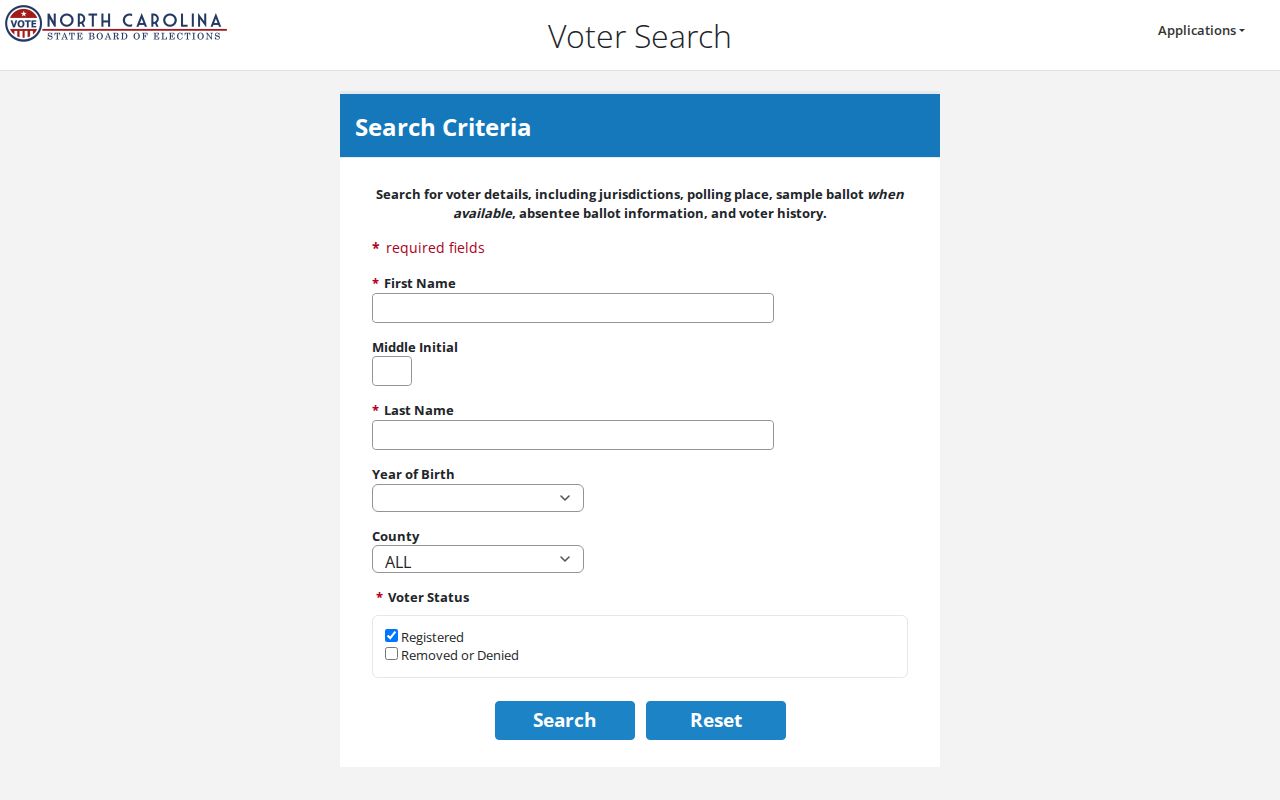
The image confirms the public entry fields without exposing the details of any real Asheville voter.
Asheville Voter Profile Fields
A matched profile is much more than a registration flag. NCSBE groups the result into voter details, jurisdictions, voting locations, sample ballots, absentee status, and voter history. Those groups help distinguish two people with the same name and show which contests apply to an Asheville address. They also make clear which data belongs to election administration rather than the person’s private ballot.
| Voter details | County, status, registration number, NCID, party or unaffiliated status, race, ethnicity, gender, registration date, and NCDMV customer indicator. |
|---|---|
| Jurisdictions | Precinct plus congressional, state legislative, court, prosecutorial, commissioner, municipal, ward, school, and other applicable districts. |
| Voting locations | Upcoming Election Day site and address, county board contact details, early-voting guidance, and a sample-ballot link when available. |
| Sample ballots | The ballot style that applies to the voter for an upcoming election, including eligible primary choices for an unaffiliated voter. |
| Absentee status | Election date, county, status, mail or early-voting type, return date, return method, and return status. |
| Voter history | Election, voting method, county, and primary ballot party where applicable, but never candidate or issue selections. |
County uploads may take weeks after an election, so a recent participation event may not appear at once. “Valid Return” in the absentee area means the ballot was successfully returned. It does not disclose how it was marked.
Note: A profile is an administrative election record, not a copy of a voter’s secret ballot.
Asheville Voter Records Privacy
North Carolina law draws a detailed line between public list fields and confidential registration data. Under N.C.G.S. § 163-82.10, a requested electronic list may contain a name, county voter ID, residence and mailing addresses, sex, race, age rather than date of birth, party, precinct and district identifiers, and voting history. Selective lists may also be requested by several of those traits.
Confidential under North Carolina law. Section 163-82.10(a1) withholds full or partial Social Security numbers, dates of birth, driver-license numbers, registration-agency identity, election-law email addresses, and voter-ID document or photo copies. A signature may be viewed but may not be copied or traced. Protected addresses receive separate safeguards.
Redaction does not make the whole voter record secret. Election officials may release the public fields while withholding protected data. Aggregate use of confidential fields is allowed only when no person can be identified from the result. This split explains why the lookup can offer a birth-year filter without publishing the exact birth date.
Asheville Voting History Has Limits
Participation history records that an election event occurred and how the voter cast a ballot. The method may be Election Day, early voting, absentee by mail, or provisional. A primary entry can identify the party ballot used where that fact applies. None of those fields reveal a vote for a candidate or position on an issue.
This is an important limit. A sample ballot shows the contests that may appear, while ballot status tracks the administrative path of an absentee ballot. Neither is the marked ballot. Public disclosure of an individual’s selections from official records can be criminal, and no Asheville voter lookup should be described as a way to discover those choices.
Note: Use participation data for lawful civic or personal research, never to pressure, frighten, or target a voter.
Download Buncombe Voter Files
The standard full-file route is the NCSBE voter registration data page. Its Buncombe County ZIP is free, needs no account or eligibility form, and is updated on Sunday evenings. The text data includes current, former, and incomplete registration rows, status and reason fields, demographics, party, residence and mailing address, county, precinct, and district fields. It excludes full birth dates, Social Security numbers, driver-license numbers, and voter history.
- Open the state voter registration data page and choose the current Buncombe County file for an Asheville-focused extract.
- Download and unzip the free file. Use the published layout to identify status, precinct, district, address, party, and registration fields.
- Download the separate weekly history file when participation is needed. Join the two data sets by NCID or by county plus registration number.
- For historic county analysis, use statewide history and filter the voted county field. A county history file follows people who are currently registered there.
Removed voters are left out of the current file when their last vote was more than ten years earlier. The separate voter history download covers the prior ten years. It carries the registration number, NCID, party, county, precinct, and voting method, so the join key matters when a person has moved.
The official download screen shown here is the direct source for current and historic election data.
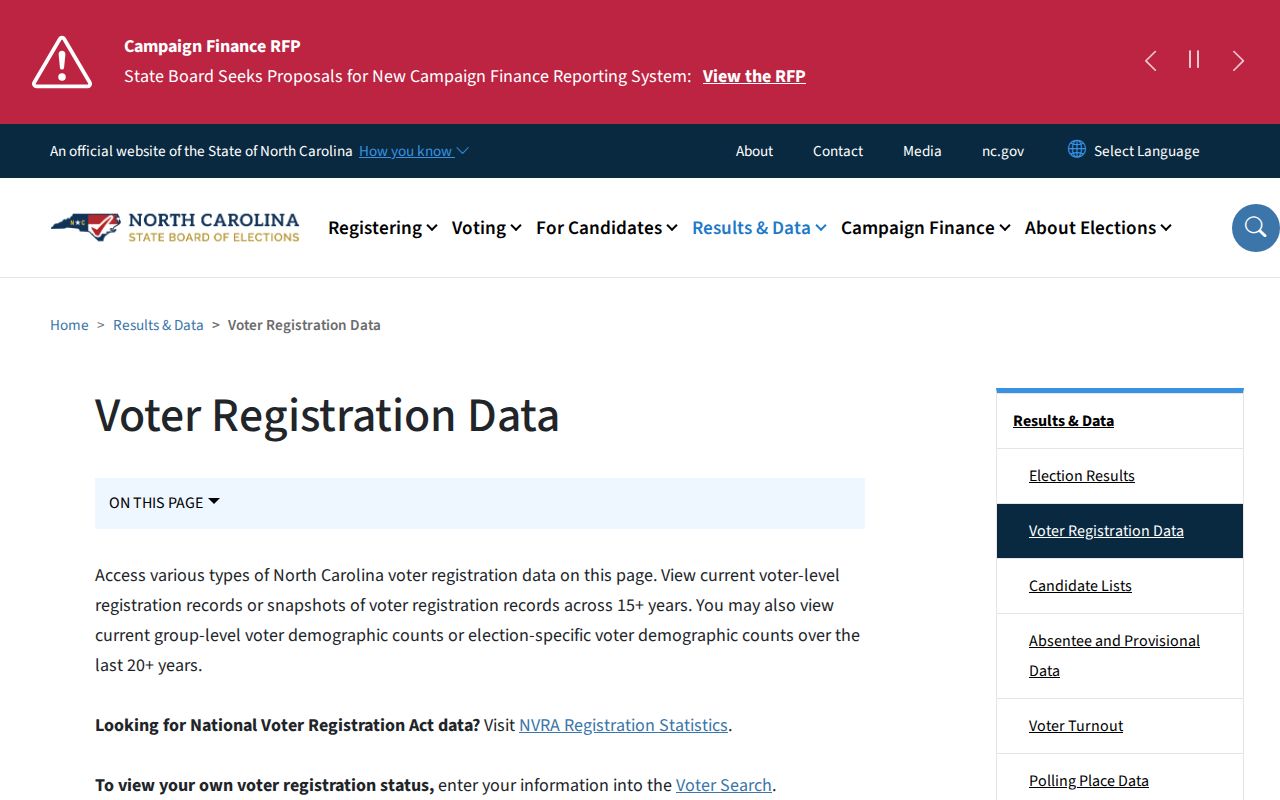
The download route is usually faster and less costly than asking Buncombe staff to prepare a custom list.
Join Asheville Voter Data
The NCID is the statewide identity key in the published election data. It links a registration row to a participation row even when local registration details change. County plus voter registration number is the documented alternate join. Names alone are weaker because spelling, suffixes, and shared names can create false matches.
Keep the distinction between where a person is registered now and where a past vote occurred. For that reason, NCSBE directs historic county analysis to the statewide history file and its voted-county field. Filtering only a current Buncombe history extract could miss a person who voted in Buncombe and later registered elsewhere.
Asheville Voter Status Maintenance
An inactive label does not mean that one missed election canceled the registration. The NCSBE maintenance account says no voting or contact for two federal election cycles triggers a confirmation mailing. An undeliverable mailing or no response can move the voter to inactive status. Removal may follow only after two more federal cycles without voting or contact.
The January through March 2025 statewide maintenance removed 498,889 registrations for several legal reasons. Of those, 419,937 followed two federal elections in inactive status. Other counts included 40,357 moved-within-state duplicates, 25,119 deceased voters, 7,017 merged or duplicate records, 2,849 felony removals, 2,784 out-of-state moves, 514 voter requests, 307 other cases, and five noncitizens.
Those figures show why status and reason fields must be read together. A removed record can reflect a move, death, duplicate, request, felony rule, or the full maintenance sequence. It should not be reduced to a claim that the person simply failed to vote.
Protected Asheville Voter Addresses
A qualifying voter may keep an address out of ordinary voter rolls. Section 163-82.10(e) covers a voter with a qualifying protective or contact-restricting court order, as well as a participant with an active Address Confidentiality Program card. The voter submits the required documentation and safety statement to the county board. The name, precinct, and other lawful public fields can remain visible.
The North Carolina Address Confidentiality Program serves qualifying survivors of domestic violence, sexual assault, stalking, and human trafficking who have moved or plan to move and fear discovery. Certified application assistants help with enrollment. The Department of Justice supplies a substitute address and forwards mail, while election officials retain the actual address for election administration.
Note: Address protection is a focused safety measure, not a general option to remove every public voter field.
Asheville Election Services Requests
Buncombe County Election Services is the local fallback when the individual lookup fails, a custom selection is needed, or a field requires explanation. The current office is at 35 Woodfin Street, Asheville, NC 28801. It is open Monday through Friday, 8 a.m. to 5 p.m. Staff may be reached at (828) 250-4200, by fax at (828) 250-6262, or at elections@buncombecounty.org. Mail goes to P.O. Box 7468, Asheville, NC 28802-7468.
The county’s maps, data, and reports page also points to the public lookup and election data tools. North Carolina law permits a person to request county or precinct lists and selective lists. A custom list can carry actual preparation cost, plus up to $25 for magnetic-media service. No dedicated state or Buncombe voter-file request PDF was found, so the free download should be tried before a custom request.
For general records-law procedure outside election data, the separate Asheville public records resource covers custodian requests and access rules.
Historical Asheville Voter Records
Old poll books and registration books follow a different path from the current voter database. The State Archives county-records guide includes election materials, and its Buncombe catalog documents county holdings. The exact years for preserved Buncombe poll books and voter registers were not exposed in the available finding aids.
Contact Election Services, the State Archives, or the Western Regional Archives with a name, precinct, election, and date range. Retention rules often permit destruction two months after certification for a nonfederal election or 22 months after certification for a federal election. Offices must contact the State Archives before destroying old poll books or registration books, but those rules do not prove that a given Asheville volume survived.
Use Asheville Voter Records Lawfully
Public access does not authorize intimidation, stalking, harassment, or prohibited commercial use. N.C.G.S. § 14-277.3A addresses repeated harassment or conduct without legal purpose when the actor knows or should know it would cause reasonable fear or substantial emotional distress. Section 14-196.3 covers specified cyberstalking conduct, including threats, harassment, knowingly false communications, and unauthorized tracking.
Use voter registration details for lawful personal research, election administration, or civic study. Do not trace a protected person, pressure someone based on participation, or imply that history reveals a ballot choice. Report election intimidation to Buncombe County Election Services at (828) 250-4200 or NCSBE at (919) 814-0700. An immediate threat belongs with emergency services.