
Start an Asheville People Search
Choose the first Asheville record by the fact already known. A full name can be tested in the Buncombe County deed index, the statewide court portal, business filings, license records, and current voter tools. An address works differently. The Buncombe County Property Record Search can turn it into an assessed owner and a 15-digit parcel identification number, or PIN. That owner name can then open the deed chain. A former address may also lead to an older city directory, permit file, tax scroll, or newspaper notice.
Identity needs more than one match. Compare a middle name, age or birth year, parcel, relative, business, or case number before treating two entries as the same person. A tax mailing address is only where the county sends a bill. It is not proof that an owner lives at the property. Court calendars show scheduled proceedings, not guilt. Good search work keeps those limits visible.
- Write down the full name, spelling variants, approximate dates, and any known Asheville address.
- Use the property roll for an address or the deed index for a name. Save the PIN, book and page, or instrument number.
- Check the eCourts party index and court-date search, then note any case number before contacting the clerk.
- For a family trail, compare directories, obituaries, estate files, cemetery evidence, and vital-record indexes.
- Ask the correct custodian for a specific existing record when the online trail ends.
Phone numbers and email addresses rarely appear as a single official city index. Current staff and business directories may publish them, while older residential contact clues often come from library directories. The Census profile for Asheville supplies community context, not an individual lookup. Official sources are strongest when they identify the record’s keeper and date.
Asheville Records Offices by Role
Asheville is the county seat, but no single counter holds every people record. The Register of Deeds keeps land instruments, assumed names, plats, and Buncombe birth, death, and marriage certificates. The Clerk of Superior Court keeps state trial-court and estate files. City offices hold city-created permits, council materials, and releasable police records. The detailed access rules and copy procedures belong with Asheville public records; the office map here helps route the first search.
Buncombe Register of Deeds
205 College Street
Asheville, NC 28801
(828) 250-4300
Online Records Search
Asheville City Records
City-created records
Asheville, NC
Online request route
Request Public Records
The Register and Clerk counters are open Monday through Friday from 8 a.m. to 5 p.m. The city request portal is for identifiable records, not general questions or emergency help. Describe the department, people or address, subject, and a narrow date range.
Search Asheville Deeds by Name
The Buncombe Register of Deeds says its land records are indexed by name. That matters when an Asheville search begins with only a street address. First use Land Records or the property portal to learn the assessed owner. Then enter that name in the deed system and follow grantor and grantee entries. A grantor transfers an interest; a grantee receives one. Trusts, businesses, middle initials, and spelling variants can all change the result set.
The Consolidated Real Property index is valid from January 1, 1995 to the present. Separate older deed and plat books extend much farther back. One verified online result reaches July 12, 1804, but that sample does not prove seamless remote coverage for every early series. The public search room remains the fallback for an index or image that is not online.
| Deed search field | Best use | Search note |
|---|---|---|
| Last or company name | Required name key | Try entity and surname variants |
| First and middle name | Narrow an individual | Older entries may use initials |
| Party type | Grantor or grantee role | Use all parties when unsure |
| Instrument type | Limit the document class | Deeds, trusts, plats, and other types differ |
| Begin and end date | Restrict the filing period | Recording date may differ from signing date |
The Buncombe deed name search shows the live entry point.
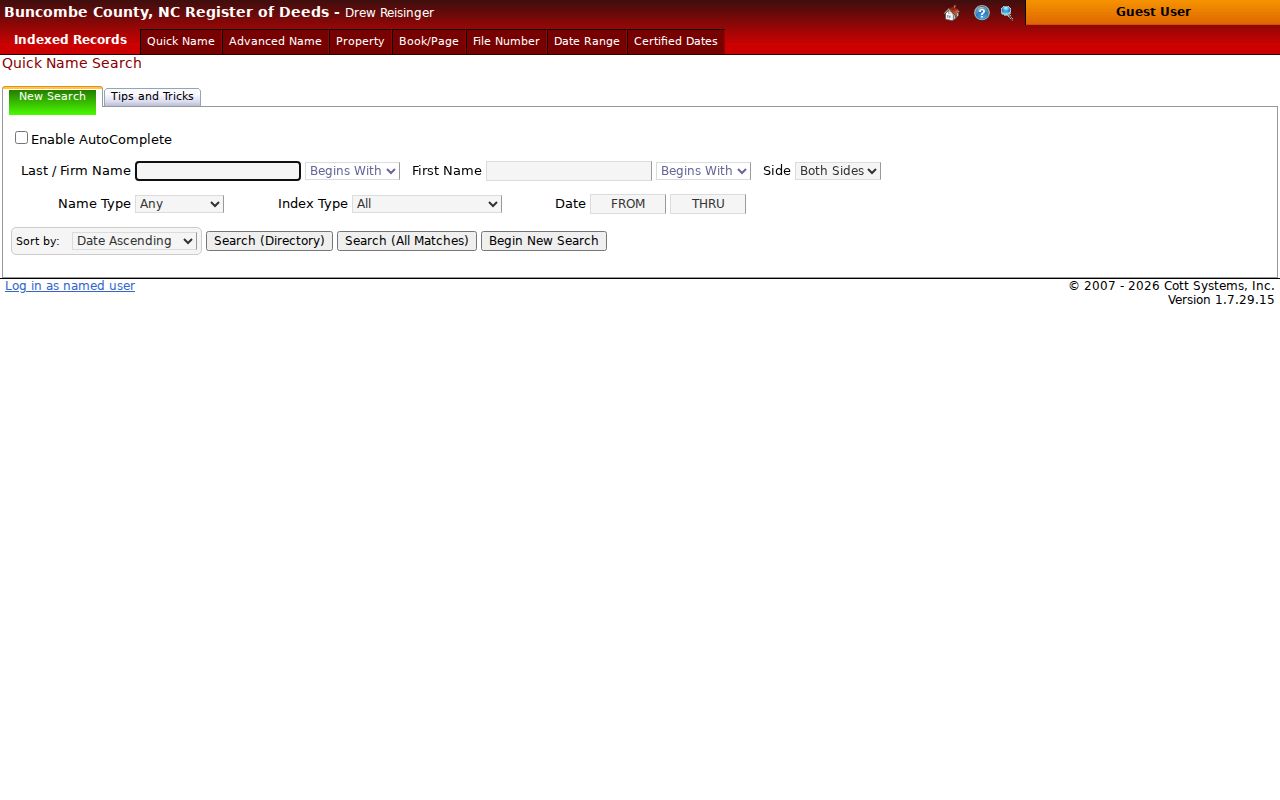
The captured interface reinforces the name-first design. Save the book, page, file number, recording date, and party role before following a linked image or asking for a copy.
Turn Asheville Addresses Into Owners
The county property tools solve the reverse problem. Search a situs address, owner name, or parcel PIN in the property portal. A parcel card commonly lists the assessed owner, tax mailing destination, physical address, legal description, values, acreage, and a sale or deed reference. “Situs” means the place where the parcel sits. The owner mailing field is where tax mail goes, which may point to a trust, company, agent, or stale address instead of a home.
Record the 15-digit PIN. It connects the property card, GIS, tax material, and deed references. If a subdivision or parcel split breaks the chain, Buncombe’s PIN History can reveal predecessor parcels, prior owners, acreage, and book or page references. Discover Buncombe adds address-based property and jurisdiction themes. Map Asheville can search an address, PIN, or owner for city layers. Open the official Buncombe property search before reviewing the captured owner-search interface.
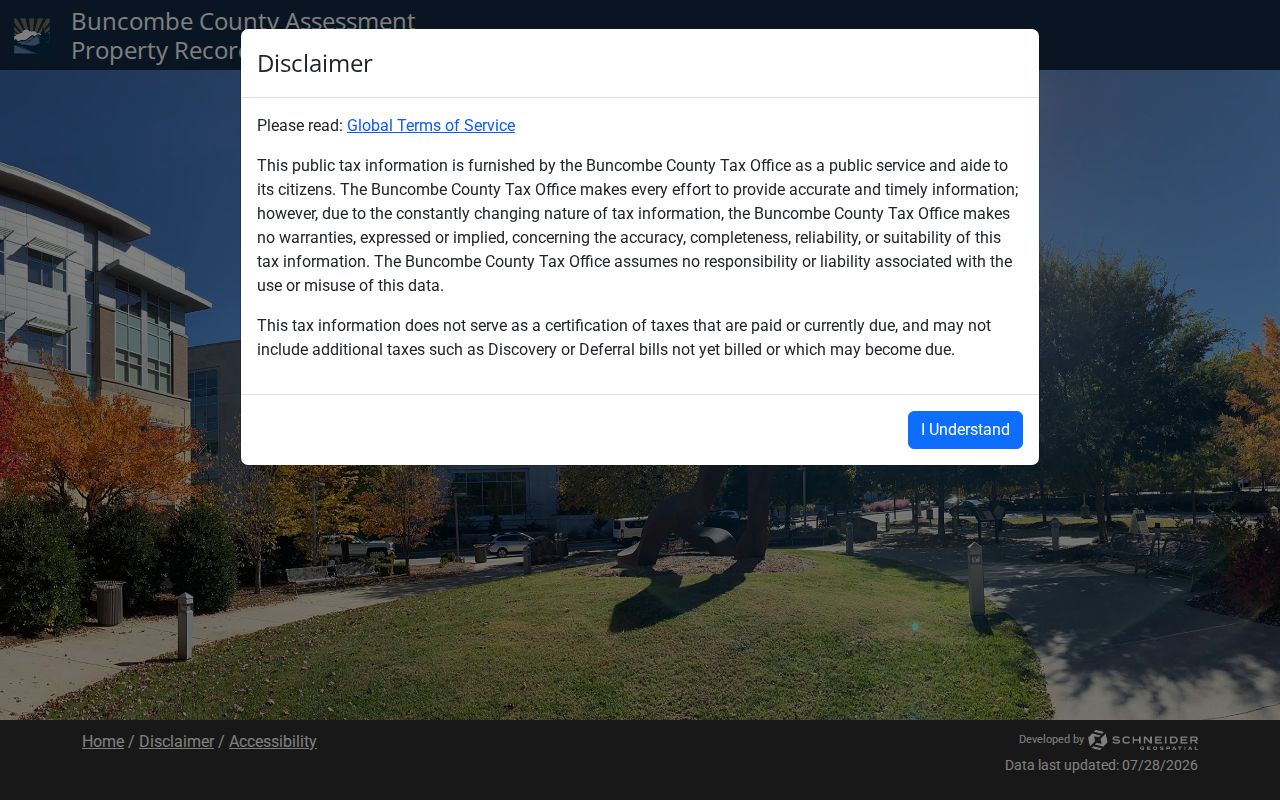
A matching owner is a link to title, not proof of occupancy. Compare deeds, directories, permits, and current records before drawing a conclusion about who lives there.
Note: County GIS is reference data, not a survey, and new plats may take five to ten business days to appear.
Check Asheville Court Records
Buncombe District and Superior Courts are state courts. Search the statewide eCourts Portal by party name or case number, then filter for the Buncombe location. A docket is the running record of a case. It can show the case number, parties, filing date, case type, status, hearings, filings, and a disposition when public. Linked documents vary. The separate court-date tool is only a calendar and cannot establish a conviction.
Use spelling variants for a common name. The official court-date search can narrow a calendar by name, citation, county, and date. Once a case number appears, ask the Clerk of Superior Court for the specific filing, complete file, or certified copy. Courthouse terminals and the counter remain important for paper, archived, and non-downloadable material. Sealed or expunged matters, juvenile and adoption files, and confidential parts of domestic or mental-health cases do not become public merely because a name was searched.
| Asheville court source | People trail | Access route | Key limit |
|---|---|---|---|
| Buncombe District Court | Civil, misdemeanor, traffic, domestic | eCourts, calendar, clerk | Some case types restricted |
| Buncombe Superior Court | Felony, larger civil, estate and special proceedings | eCourts and clerk | Portal may omit documents |
| Western District of North Carolina | Federal civil and criminal cases | PACER and federal clerk | Account and federal fees may apply |
Trace Asheville Vital Records
The Buncombe Register of Deeds issues local birth, death, and marriage certificates, while N.C. Vital Records handles statewide certificates and divorce certificates. The Clerk of Superior Court keeps the actual divorce case. A state divorce certificate is not the same as the pleadings or decree. For a recent Buncombe event, the local register may be the most direct certificate route; statewide and special records may require the state office.
North Carolina does not use a simple rule that every birth or death certificate becomes unrestricted after a set number of years. Under N.C.G.S. § 130A-93(c), certified copies are limited to the person, specified relatives, authorized agents, attorneys, or someone who needs the information for a legal determination. Uncertified copies may be available unless another law restricts them. Delayed births and adoption material carry added limits.
- Index
- A finding aid that points to a record, not a certified certificate.
- Certified copy
- An official copy authenticated by the custodian for legal use.
- Decedent
- The person whose death is recorded.
- Informant
- The person who supplied facts for a death record and may reveal family context.
Historical research can move to State Archives microfilm, Buncombe Special Collections, church registers, cemeteries, and newspapers when certificate access is limited. Those sources provide leads, but they do not change certified-copy eligibility.
Browse Asheville Historical Directories
Buncombe County Special Collections at Pack Memorial Library is the best local fallback when a current portal cannot reach an earlier resident. Its guides describe Asheville city directories from 1883 to the present. DigitalNC offers 57 digitized issues from 1883–84 through 1963, with gaps. Entries may list a resident’s address, occupation, spouse or widow notation, and business. The 1960 Hill volume adds a reverse street section and a numerical telephone section.
A reverse directory begins with the street and house number instead of the surname. That makes an old address useful even when the resident’s name is unknown. The library also provides access to the Asheville Citizen Times full-text archive from 1999 to current, Ancestry Library Edition, NC LIVE, and business or residential directory data. Authentication rules vary, and staff should confirm exact physical volumes or uncataloged collections.
An address in a directory records an occupant for that edition. It does not prove ownership. Pair it with a tax roll or deed, then use an obituary, estate file, cemetery record, or later directory to extend the Asheville people trail.
Find Asheville Heirs Across Records
An heir search works best as a chain. Start with the Buncombe estate case and identify the personal representative, claimants, or named family. Follow any deed from the estate for grantor and grantee names. Search an obituary or funeral notice for relatives, then compare vital and cemetery evidence. A service address, tax mailing address, or newspaper statement is a lead until another source confirms it.
Riverside Cemetery adds an unusually strong Asheville source. City history traces it to 1885 and describes more than 14,000 burials and 10,000 monuments. Interment registers, plot maps, marker photographs, and archival fragments can supply a date, plot, inscription, or relationship. Historical and genealogical appointments are available through the cemetery at 53 Birch Street.
Sealed adoption records are not bypassed through an open-record request. A birth-relative search must use lawful state registry, agency, or court-authorized channels.
Asheville Searches Cross Boundaries
An “Asheville, NC” mailing address may sit outside Asheville city limits. Postal geography, the municipality, and Buncombe County overlap without matching perfectly. That changes which police, permit, planning, or tax office owns a record. Use the official city-limits layer and Discover Buncombe before assuming city jurisdiction. The county’s property, deed, and court systems still cover Asheville because the city lies within Buncombe County.
Historic street names add another split. Today’s Biltmore Avenue and Broadway were South Main and North Main until 1914. Sources have also used Broadway Street and Broadway Avenue. Search both suffixes and the earlier Main names when a directory, deed, or newspaper returns nothing. The 1887 city directory used a Public Square-centered numbering method, so an old house number may not align with current GIS.
Note: Ownership, occupancy, postal delivery, emergency addressing, and legal land descriptions answer different questions and should not be treated as interchangeable.
Check Asheville Custody Records
The Buncombe detention catalog focuses on current custody and booking context. It is not proof of guilt or a complete court file. The N.C. Department of Adult Correction search adds current and former state supervision or confinement, with name, offender number, status, demographic filters, and public sentence information. Use a date, age, or offender number to separate people who share a name. City permit files follow a different route through Asheville Development Services.
The N.C. State Bureau of Investigation registry supports name and geographic searches for public adult registration data. It carries an anti-misuse warning and is not a general criminal-history tool. When a catalog or registry entry matters, verify the identity and case through the court source. For releasable Asheville police reports, use the city records route or APD Records Unit; investigative, victim, juvenile, and protected fields may be withheld.
Verify Asheville Business Connections
The N.C. Secretary of State business search can connect a person with an entity through a registered agent, company official, formation record, or filed address. Buncombe assumed-name certificates add local DBA parties through the Register of Deeds index. Professional license checks are decentralized. Start with the state boards directory, identify the correct board, and then use that board’s name or license-number search.
Unclaimed property offers a different name trail. The official NCCash search is free and may identify property held for an owner, but a claim requires identity checks.
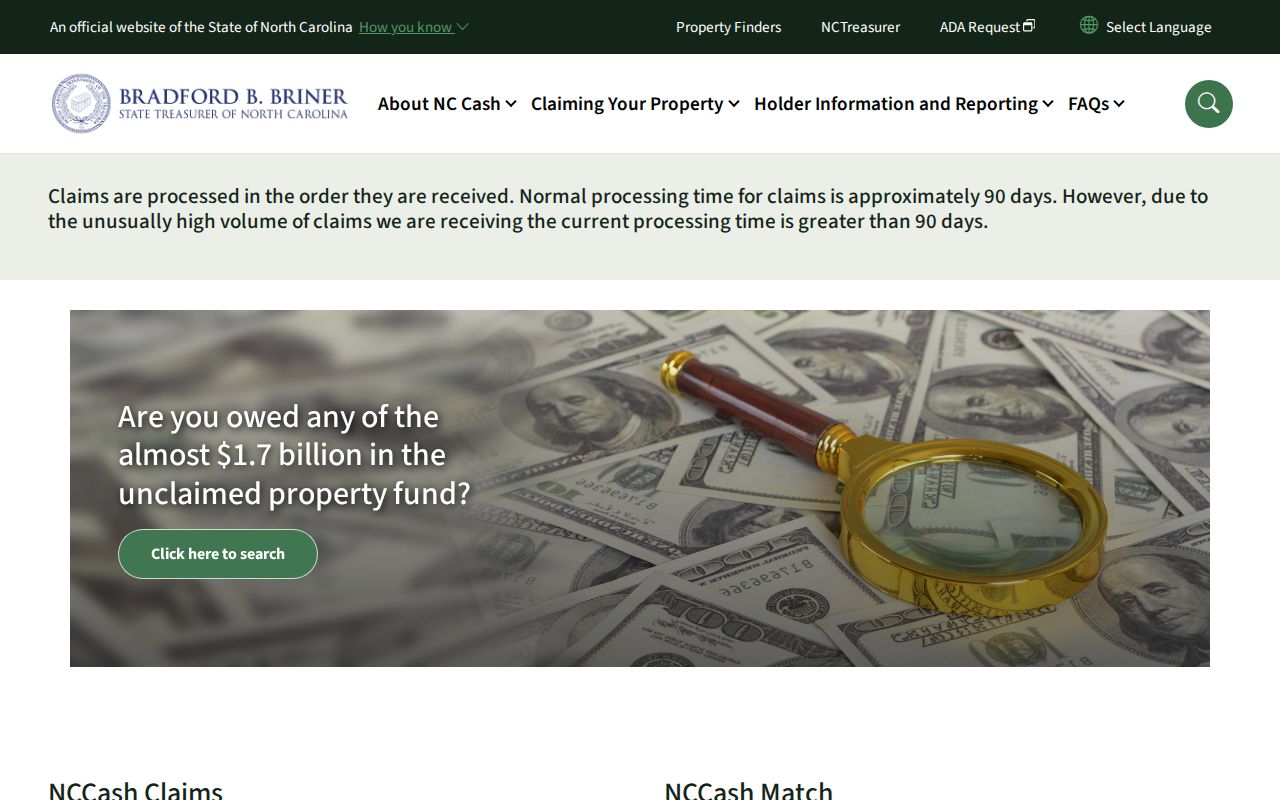
The official interface avoids fee-based solicitations. Treat any match as a prompt to use the Treasurer’s claim process, not as proof that two same-named people are identical.
Request Missing Asheville Records
Many useful files never appear in a public web index. Asheville permit review before 2019 can remain on paper. A court document may be available only at the clerk’s terminal or in an archived file. Early deeds may require a separate book index or the Register’s public search room. Special Collections also holds uncataloged archival boxes that require staff help.
For city-created material, use Asheville’s request service and identify the department, record type, names or address, subject, and date span. North Carolina Public Records Law, N.C.G.S. Chapter 132, requires inspection and copies at reasonable times and “as promptly as possible.” It sets no fixed response-day deadline. A custodian need not create a new record or answer a broad people-search question.
Visit the City of Asheville records request route to see the official submission path.
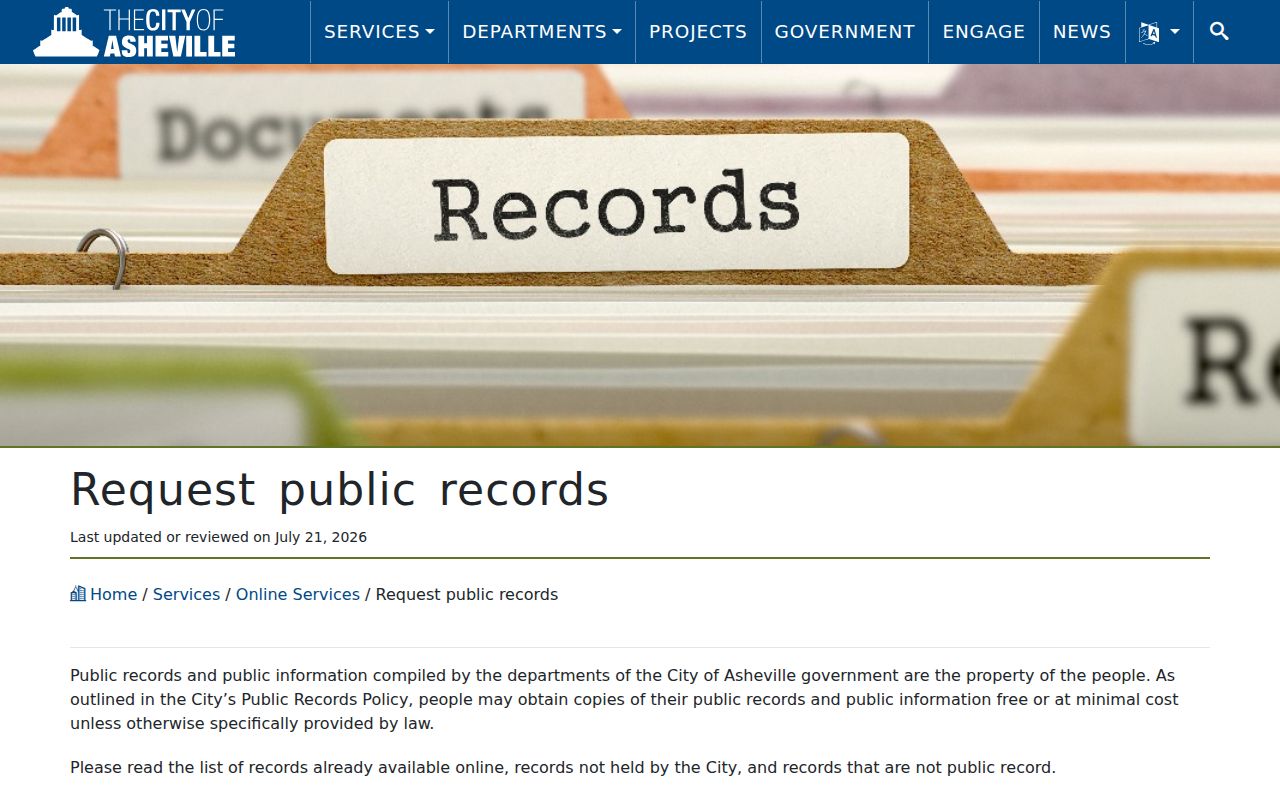
The page routes city records only. Deeds, court files, vital records, taxes, and elections belong to county or state custodians, so send each request to the office that created or keeps the record.
Compare Asheville Search Sources
Official records and commercial compilations serve different roles. A compilation may connect a name with a phone, email, address, or relative, but it can lag behind source changes or merge people. The custodian’s dated index, image, or certified copy is the stronger source for a specific public fact.
| Search source | Useful for | Main caution |
|---|---|---|
| Official online index | Fast name, case, parcel, or filing lead | An index may omit the document image |
| Office counter or request | Full file, archive retrieval, certified copy | Requires a specific record identifier |
| Library and archives | Historical residents, addresses, family context | Coverage has gaps and catalog limits |
| Commercial compilation | Possible contact lead | May be stale, mixed, or unsupported |
Confirm a commercial lead at the deed office, court, election authority, licensing board, library, or other named keeper. Do not republish sensitive data simply because it appeared in an old document.
Asheville Court Fires Left Gaps
Buncombe County formed in 1791. Courthouse fires in 1830 and 1865 destroyed many court records, so a missing early case may reflect real loss rather than a poor search. The State Archives’ Buncombe collection is still large: 726 cubic feet, 43.33 gigabytes, and 6,908 microfilm reels. That scale shows why a single online search cannot represent the whole surviving record landscape.
Build redundancy into historical Asheville research. When a court file is gone, compare deeds, tax books, directories, newspapers, church or cemetery material, and later estate records. The Register’s Slave Deeds project also provides book and page indexing for names embedded in records of slavery and links them to the Digital Library on American Slavery. Those records require care with their original, oppressive legal context.
Preserve Asheville’s Helene Stories
Buncombe County Special Collections launched the Come Hell or High Water archive in January 2025 to preserve community accounts of Tropical Storm Helene. By December 2025, the project held 1,033 contributions from at least 257 people and had reached 7,877 United States web users. Oral histories, photographs, documents, and community records can preserve people who never appear clearly in a deed or court index.
The project sits beside the Black Asheville History Project, West Asheville History Project, and Blue Ridge Pride archive. These community collections complement government records rather than duplicate them. They can establish a person’s role in a neighborhood, organization, or shared event, with the context that a bare official entry lacks.
Current and historical Asheville people search work is strongest when it respects both systems: official custodians establish record facts, while local archives preserve voices, relationships, and memory.